
Nasikia Mobile Migration Camp
Bologonja, Northern Serengeti (June–October) / Small Marsh, Ndutu (December–March) — Nasikia Camps
Nasikia Mobile Migration Camp relocates twice a year between two positions chosen for the migration’s key phases. From June to October, the camp sets up at Bologonja in the far northern Serengeti, within reach of the Mara, Sand and Bologonja Rivers and their crossing points. From December to March, by contrast, it moves to the Small Marsh area of Ndutu, in the Ngorongoro Conservation Area, positioned for the wildebeest calving season.
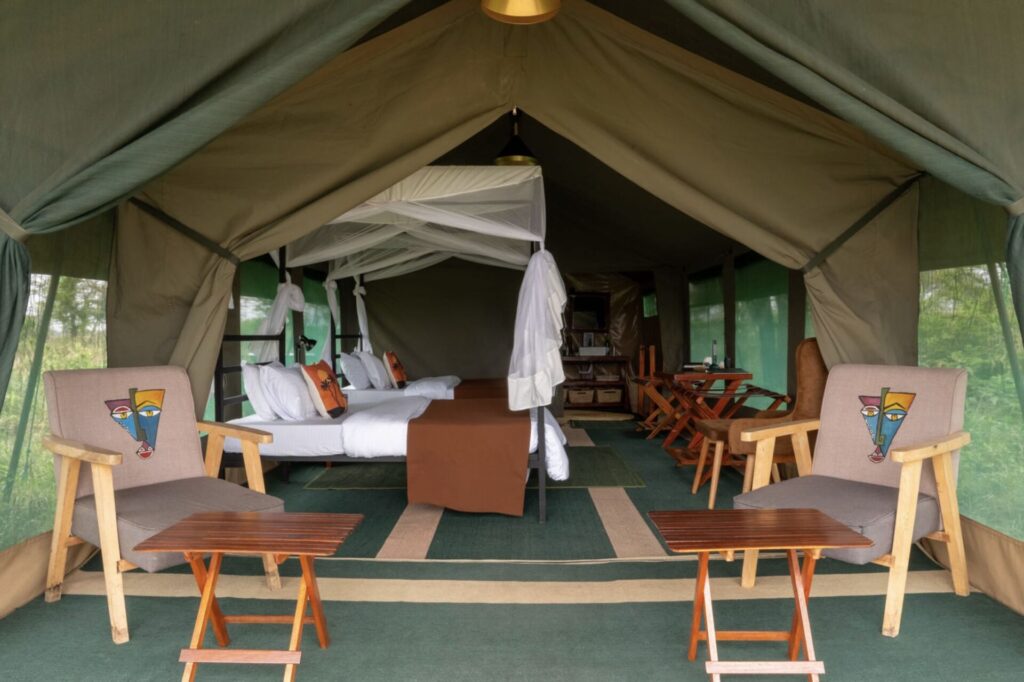
The camp keeps a deliberately unpretentious, traditional safari character. Meru-style canvas tents, bucket showers, and a genuinely affordable route into witnessing the migration set it apart from many of the Serengeti’s more elaborate camps.
Location and Landscape
In its northern position, the camp sits well placed for river crossings. These typically occur between mid-July and mid-September, as herds run the gauntlet of crocodiles at the Mara, Sand and Bologonja Rivers. In its southern position at Ndutu’s Small Marsh, however, the camp sits amid the calving herds gathering to give birth. Late January to late February, generally, marks the most concentrated window for new life on the plains.
Accommodation
The camp comprises ten mobile tents at its northern Bologonja site and up to twelve at its southern Ndutu site. Each tent runs roughly 12 by 4 metres, built from rip-stop canvas with a cooling shade-cloth exterior. Every tent includes, in addition, a private patio, mosquito-netted beds, and an en-suite bathroom with a flushing toilet and a bucket shower. One family-configured tent connects two sleeping areas for travelling families. Solar power runs the camp, with a generator providing backup, and Wi-Fi remains available in the main communal areas too.
Safari Experience
Twice-daily game drives explore the surrounding plains according to the camp’s current position. Experienced guides lead these drives, with detailed local knowledge of the migration’s movement. Guests can also book guided walking safaris with an armed walking guide, and hot air balloon safaris at additional cost, generally followed by a champagne breakfast in the bush. Evenings, finally, gather around the campfire before dinner, served either communally or under the stars.
The camp also runs community development commitments in partnership with villages bordering the Serengeti and Ngorongoro. As a result, this channels a portion of camp income toward local education and employment initiatives.
When to Visit
Mid-July through mid-September brings the strongest river-crossing activity to the camp’s northern position. Late January through late February, meanwhile, brings the most concentrated calving activity to the camp’s southern position at Ndutu. The camp closes between its two seasonal windows as it relocates.
Practical Information
When positioned in the north, guests reach the camp via the Kogatende airstrip, roughly 45 minutes by road. When positioned in the south, instead, the Ndutu airstrip sits roughly 20 to 25 minutes away. The camp also welcomes children aged 5 and older.
Combining Nasikia Mobile Migration Camp with Other Tanzania Destinations
Nasikia’s seasonal movement pairs naturally with a stay at a fixed lodge elsewhere in the Serengeti. This gives travellers both the mobility of a migration-tracking camp and the additional facilities a permanent property offers. Ngorongoro Crater and Tarangire, similarly, both extend into a wider northern Tanzania circuit, and Zanzibar, finally, offers a coastal close to the journey.
Our Tanzania Safari Guide covers wider planning. For all Tanzania regions, see Luxury Tanzania Safari Lodges.
If you are considering Nasikia Mobile Migration Camp as part of a Tanzania safari, we would be glad to talk it through.