
Namibia Safari Guide | Regions, Seasons and Planning | Oloi Shorua
Namibia Safari Guide
Regions, seasons, cost and planning — a considered overview
Namibia asks a different question of the safari traveller than East or Southern Africa’s wetter ecosystems. Here, the landscape itself is frequently the primary subject. Wildlife is present, and in places remarkable, but it exists in relation to a degree of aridity that shapes how animals behave, where they move, and how rarely they gather in large numbers. This is not a country of dense game-viewing circuits. It is a country of space, geology and adaptation.
This Namibia safari guide sets out the regions, seasonal logic and planning considerations behind a well-built Namibia journey. Particular attention goes to how the country’s desert character changes the safari experience itself, not just the scenery around it.
For broader regional context, see our Safari Guide — Africa, or compare with neighbouring Botswana Safari Guide and South Africa Safari Guide.
Why Travel to Namibia
Namibia is one of the least densely populated countries on earth, and the resulting sense of scale is difficult to convey until experienced directly — distances between regions are measured in hours of driving through landscapes with no settlements, and the night sky over the Namib, largely free of light pollution, reveals a density of stars rarely seen from any inhabited place.
The wildlife that survives here has adapted specifically to aridity, and that adaptation is itself the draw. Desert-adapted elephant in Damaraland travel further between water sources than elephant anywhere else in Africa. Black rhino in the same region exist entirely outside fenced reserves, tracked on foot across open terrain by community-employed trackers. This is wildlife viewing built on scarcity and adaptation rather than abundance, and it rewards a traveller’s patience and curiosity in a genuinely different register.
Main Safari Regions
Etosha National Park
Etosha centres on a vast salt pan roughly 5,000 square kilometres in size, a relic of an ancient lake. Waterholes scattered along its margins draw wildlife consistently, particularly through the dry season between June and October. This is Namibia’s most conventional wildlife-viewing destination. Elephant, lion, black rhino and substantial herds of springbok and oryx gather predictably at these waterholes, making it the most reliable region in the country for travellers who prioritise sighting density over landscape and solitude.
The park’s south and east, accessible by self-drive on good roads, contrasts with private concessions along its western boundary, where access is limited to guests of specific lodges and game viewing carries considerably more exclusivity.
Damaraland
Damaraland’s stark, mountainous terrain holds Namibia’s most distinctive wildlife story. A population of desert-adapted elephant and one of the largest free-roaming black rhino populations in Africa both survive here entirely outside fenced protected areas. Rhino tracking happens on foot, led by trackers drawn substantially from the local community, in a model that ties conservation outcomes directly to local economic benefit. It remains among the most studied and replicated approaches to community conservation on the continent.
The region also holds some of Namibia’s most significant rock art sites, including Twyfelfontein, a UNESCO World Heritage Site with engravings dating back several thousand years. Dramatic geological features such as the Brandberg massif and the Organ Pipes basalt columns sit nearby, adding further depth to a Damaraland stay.
Sossusvlei and the Namib-Naukluft
Sossusvlei holds some of the tallest sand dunes on earth, rising in places beyond 300 metres above the surrounding gravel plains. Their colour shifts through deep orange and red as the light moves across the day. Dead Vlei sits within the same system — a stark white clay pan studded with the blackened skeletons of camel thorn trees, dead for centuries in the arid climate. It has become one of the most photographed landscapes in Africa.
Wildlife here is sparse by design — oryx, ostrich and the occasional jackal moving across an otherwise wildlife-empty landscape. The region is visited primarily for its geology and light rather than for game viewing, making it a counterpoint rather than a substitute for Etosha or Damaraland.
The Skeleton Coast
Namibia’s northern Atlantic coastline takes its name from the shipwrecks and whale bones that once littered its shore, a consequence of dense fog generated where the cold Benguela current meets the desert heat. Reaching the more remote northern sections requires a fly-in itinerary, generally arranged through a small number of specialist operators. The experience here is defined by an almost total absence of human presence, with vast dune fields meeting the ocean directly. Seal colonies and desert-adapted brown hyena are among the more distinctive sightings.
Kaokoland and the Caprivi Strip
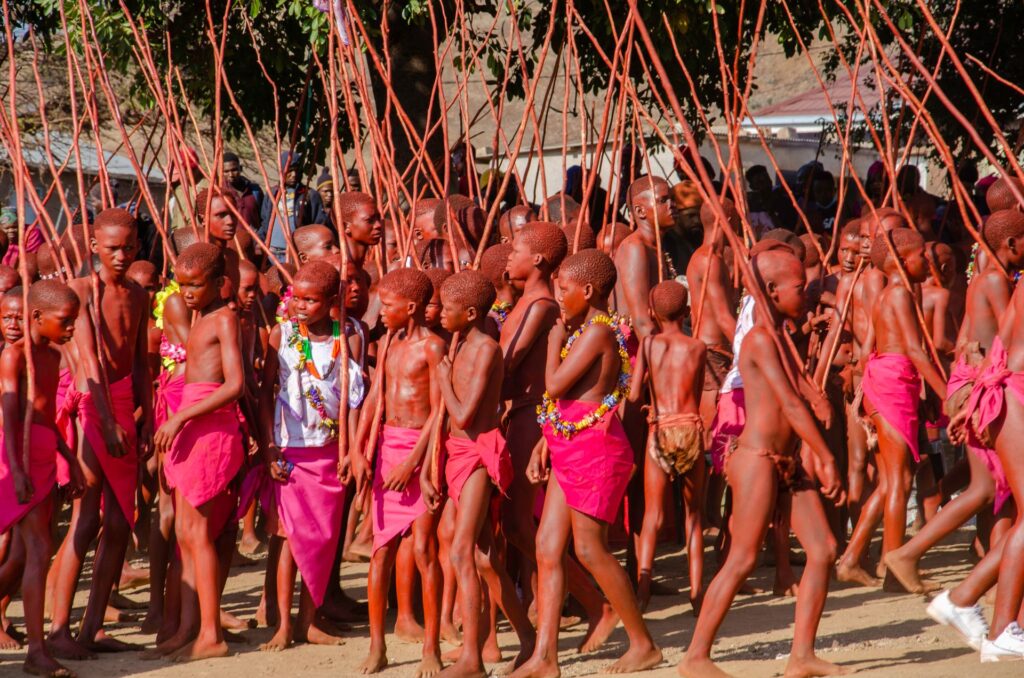
In Namibia’s far north, Kaokoland remains one of the country’s least visited regions, home to the Himba people, whose pastoral way of life and distinctive ochre-based dress have continued with limited external influence. Visits here, arranged respectfully and generally through guides with established community relationships, offer cultural depth rather than wildlife density.
Further east, the Zambezi Region — formerly known as the Caprivi Strip — extends Namibia into a wetter, more conventional safari landscape bordering Botswana’s Chobe and Zambia’s river systems, with riverine wildlife and birdlife that contrasts sharply with the arid character of the rest of the country.
Wildlife Highlights
- Desert-adapted elephant: found in Damaraland and the Kunene region, these elephant travel considerably further between water sources than elephant elsewhere in Africa.
- Black rhino: Damaraland’s free-roaming, unfenced population is tracked on foot and represents one of the continent’s most significant rhino conservation successes.
- Desert lion: a small, closely studied population survives along the Kunene region and parts of the Skeleton Coast, adapted to hunting in extremely arid conditions.
- Cheetah: Namibia holds one of the largest free-ranging cheetah populations in the world, much of it outside formally protected areas.
- Oryx (gemsbok): Namibia’s national animal, visible across Etosha, the Namib and most arid regions, adapted to survive for extended periods without drinking water.
Best Time to Visit Namibia
Namibia’s seasons affect different regions differently, and this Namibia safari guide treats timing as a function of which landscapes a traveller prioritises — wildlife concentration in Etosha follows a different logic to comfortable conditions in the Namib.
May to October
The dry season and the most reliable period for game viewing in Etosha, as wildlife concentrates around the park’s waterholes. Days are warm and dry; nights, particularly in June and July, can be sharply cold, especially in the desert regions.
November to April
The wet season. Rain falls intermittently rather than continuously, and the landscape turns green, dispersing wildlife in Etosha away from fixed waterholes and reducing predictability of sightings. This period suits travellers prioritising the Namib’s scenery and milder desert nights over concentrated game viewing.
December to March
The hottest months, particularly in the Namib and Damaraland, where daytime temperatures can become genuinely demanding. Early morning activity planning becomes more important during this window.
Different Travel Styles
Self-Drive Itineraries
Namibia’s well-maintained gravel road network and low traffic density make it one of Africa’s more practical self-drive safari destinations, suited to travellers who want to set their own pace between Etosha, the Namib and Damaraland without a guide present throughout.
Fully Guided, Fly-In Journeys
Combining light aircraft transfers between Etosha, Damaraland, the Namib and the Skeleton Coast removes the long drive times and opens access to private concessions and the more remote northern coastline, generally suited to travellers prioritising time efficiency and exclusivity over the self-drive experience.
Landscape and Geology-Focused Journeys
Built primarily around Sossusvlei, the Namib-Naukluft and the Skeleton Coast, this style treats wildlife as a secondary feature behind dune photography, geology and the scale of the desert itself.
Conservation and Community-Focused Journeys
Centred on Damaraland’s rhino tracking and, where appropriate, respectful cultural visits in Kaokoland, this style suits travellers specifically drawn to Namibia’s community conservation model rather than conventional game-drive viewing.
Practical Planning Considerations
- Distances: regions in Namibia sit considerably further apart than in most safari countries; a realistic itinerary allocates full driving or flying days between major stops rather than treating transfers as incidental.
- Self-drive versus fly-in: the choice meaningfully changes both pace and access — self-drive suits independent travellers comfortable with long distances, while fly-in opens private concessions and remote coastal areas unreachable by road in a reasonable time.
- Pace: two to three nights per region is generally sufficient given the lower density of activities relative to wildlife-dense countries; rushing through Namibia tends to reduce it to a series of drive-bys rather than a considered journey.
- Temperature swings: desert regions can shift from cold pre-dawn starts to considerable midday heat within the same day, which is worth factoring into both clothing and activity scheduling.
Entry Requirements
Many nationalities receive visa-free entry to Namibia for tourism stays of up to 90 days, though requirements vary and are worth confirming directly ahead of travel. A passport valid for at least six months beyond the date of travel is generally required, along with proof of yellow fever vaccination for travellers arriving from, or having transited through, certain countries. Given the prevalence of self-drive itineraries, an International Driving Permit is also worth arranging in advance.