
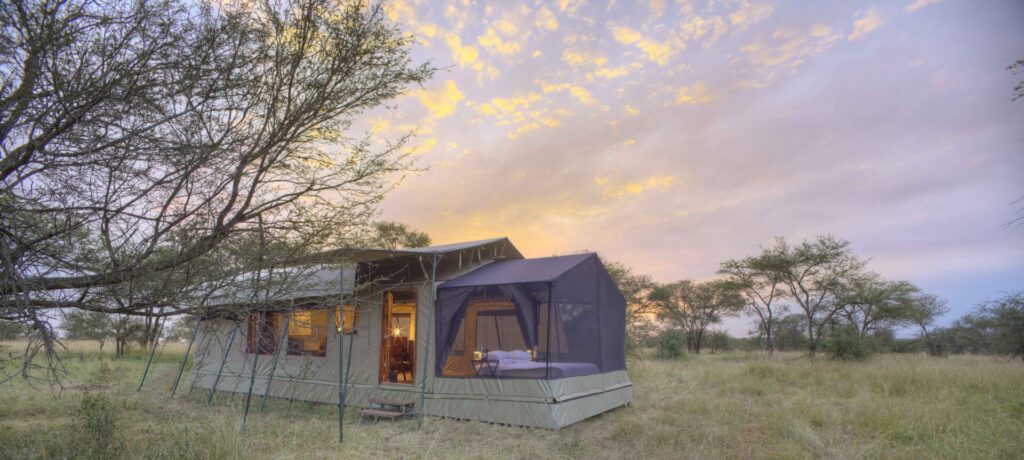
Olakira Migration Camp, Serengeti
Mara River (June–November) / Ndutu, Southern Serengeti (December–March) — Asilia Africa
Olakira Migration Camp relocates twice a year between two positions in the Serengeti. This places guests close to whichever phase of the Great Migration unfolds at the time. From June to November, the camp sits in the far north near the Mara River. It sits close to the Makutano crossing point, where the Bologonja stream meets the Mara. From December to March, the camp moves to Ndutu in the far south, positioned for the wildebeest calving season on the open plains.
Each of the camp’s ten tents sits on a raised wooden deck. A dedicated stargazing section opens directly to the night sky from every tent, a detail that has become one of Olakira’s signature touches.
Location and Landscape
In its northern position, Olakira sits within reach of resident lion, leopard, cheetah and a healthy population of plains grazers. River crossings, in addition, typically run from August through October. Guests occasionally spot black rhino in this area, while hippo regularly graze near the tents themselves. When the camp moves south to Ndutu, the open plains and seasonal lakes support thousands of wildebeest gathering to give birth. This, in turn, draws predators and scavengers into a concentration of activity that defines the calving season.
Accommodation
Olakira’s ten tents are spacious and stylish, each raised on a wooden deck. Every tent includes an en-suite bathroom, flushing toilet and hot water shower, alongside a mesh stargazing panel for sleeping beneath the open sky. One family-sized tent includes separate bedrooms. Solar power runs the camp, with a generator providing backup. Because of its semi-permanent construction, the entire site can relocate twice yearly with minimal lasting impact on the land.
Safari Experience
Open-vehicle game drives explore the surrounding plains according to the camp’s current position. Guests can also arrange hot air balloon safaris at additional cost. Meals draw on locally sourced organic produce. Breakfast often arrives as a picnic during the morning drive, while dinner runs either in the dining area or under the stars.
When to Visit
July and August are the busiest months in the north, as the migration builds toward peak crossing activity. This typically runs from mid-July to late October. In the south, calving usually begins in January and continues through February, drawing intense predator activity and excellent photographic conditions. By mid-March, the herds begin to fracture and move north and west. The camp then closes for the rains in April and May, before reopening in its northern position in June.
Practical Information
When positioned in the north, Olakira is reached via the Kogatende airstrip, roughly 45 minutes by road from camp. When positioned in the south, instead, the Ndutu airstrip sits only 20 minutes away. The camp welcomes children aged 5 and older, with a family tent offering separate bedrooms.
Combining Olakira Migration Camp with Other Tanzania Destinations
Olakira’s seasonal movement pairs naturally with a stay at a fixed lodge elsewhere in the Serengeti. This gives travellers both the mobility of a migration-tracking camp and the additional facilities a permanent property offers. Ngorongoro Crater and Tarangire, similarly, both extend into a wider northern Tanzania circuit. Zanzibar, meanwhile, offers a coastal close to the journey.
Our Tanzania Safari Guide covers wider planning. Nearby options, meanwhile, sit within Serengeti Safari Lodges. The full country collection, finally, appears at Luxury Tanzania Safari Lodges.
If you are considering Olakira Migration Camp as part of a Tanzania safari, we would be pleased to begin with a conversation.