
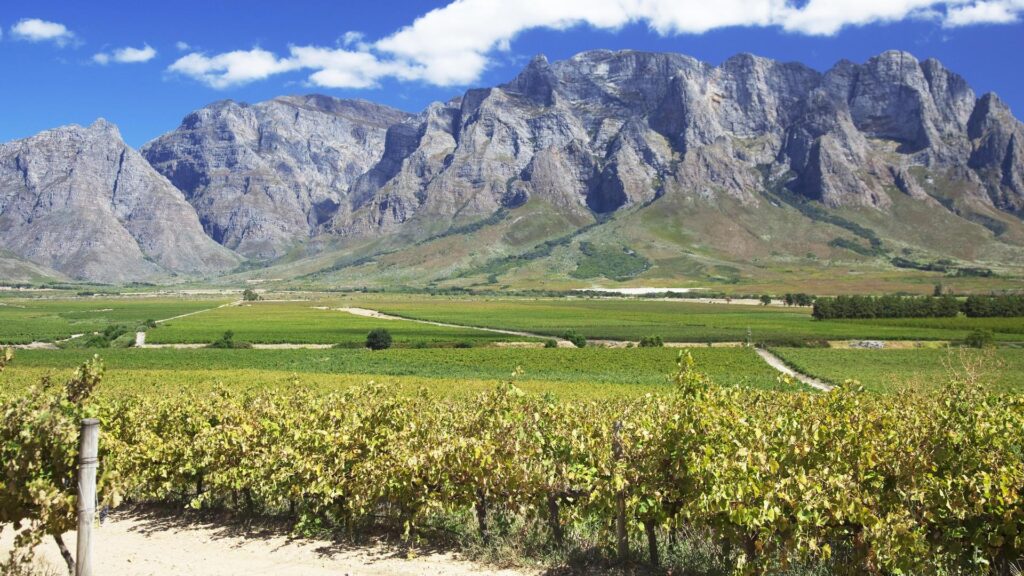
South African Winelands
The Winelands sit roughly forty-five minutes inland from Cape Town, across Stellenbosch, Franschhoek and the surrounding valleys. Centuries of winemaking history, gabled Cape Dutch architecture and some of South Africa’s most celebrated restaurants, as a result, give the Winelands a character distinct from the coast or the bush. Background on the wider region is also available from Wine Cellar South Africa.
At Oloi Shorua, we recommend a small selection of estates across Franschhoek and Stellenbosch, each built around a working vineyard or wine programme rather than simply located near one.
Why the Winelands Belong on a South Africa Itinerary
The Winelands work well as a one- to three-night addition either side of Cape Town, or as a base for travellers prioritising food and wine over wildlife. Franschhoek, in particular, has built a reputation as the valley’s culinary capital, with several of the country’s most highly regarded restaurants within a short drive of each other. Stellenbosch, the older and larger of the two towns, adds a deeper concentration of historic estates, many open for tastings and cellar tours throughout the day.
The region’s appeal runs beyond the wine itself. Cape Dutch gables, whitewashed farmhouses and oak-lined avenues give the Winelands a visual identity unlike anywhere else in South Africa, shaped by Huguenot settlers who arrived in the late seventeenth century. Many of today’s working estates trace their own history back several hundred years, and several still farm the same land their founders first planted. That continuity shows up in small details throughout a stay, from family portraits in a manor house dining room to cellar buildings that predate the surrounding town.
Key reasons to include the Winelands:
- Some of South Africa’s most celebrated restaurants, concentrated in and around Franschhoek
- Centuries-old wine estates, many open for tastings and cellar tours
- Cape Dutch architecture and landscaped gardens distinct from anywhere else in the country
- A short, easy transfer from Cape Town, suiting both day trips and longer stays
Luxury Estates in the Winelands
Our Winelands collection spans five properties, each chosen for a distinct character within the region rather than simple proximity to a tasting room.
- La Residence — a private 30-acre estate with a palatial, maximalist interior style
- Leeu Estates — a restored 19th-century manor house and the flagship of the Leeu Collection
- Delaire Graff Estate — atop the Helshoogte Pass, with sixteen lodges and two Michelin Keys
- Babylonstoren — a historic Cape Dutch farm built around an eight-acre edible garden
- Mont Rochelle — Sir Richard Branson’s working vineyard estate above Franschhoek
Travellers wanting a maximalist, theatrical take on Winelands luxury tend toward La Residence, while those drawn to art and a working farm setting often choose Leeu Estates instead. Delaire Graff suits guests wanting the most polished, design-forward version of the region, and Babylonstoren remains the natural choice for anyone whose interest leans toward the garden and the kitchen as much as the cellar. Mont Rochelle, finally, offers a genuinely working vineyard with a separate Manor House for exclusive-use family bookings.
Wine, Food and the Wider Winelands Experience
Wine tasting forms the obvious centrepiece of any Winelands stay, but the region rewards travellers who build in time beyond the cellar. Franschhoek’s restaurant scene draws diners from across the country, and several estates run their own acclaimed kitchens alongside the tasting room. Stellenbosch, meanwhile, holds South Africa’s second-oldest town centre, with university-town energy alongside its winemaking history.
The wines themselves cover genuine range, from internationally recognised Bordeaux-style blends to increasingly well-regarded Chenin Blanc and Pinotage, the country’s own signature grape. Many of the estates we recommend run tastings led by the winemaker or a senior member of the cellar team, rather than a generic tasting menu, giving guests a real sense of how a particular vintage came together. Several also hold considerable private collections of older vintages, available by request for guests wanting to explore beyond the current release.
Beyond the vineyards, the Winelands offer hiking in the surrounding mountains, horse riding through vineyard rows, and the Franschhoek Wine Tram for travellers wanting to explore several estates without driving themselves between tastings. Art features prominently too, with galleries and sculpture gardens woven into a number of the region’s working farms. Cycling has also grown into a genuine local pastime, with quiet farm roads connecting many of the valley’s best-known estates.
When to Visit the Winelands
The Winelands work year-round. Late spring through autumn, roughly October to April, however, brings the warmest, driest weather for exploring vineyards and dining outdoors. Harvest season, generally February and March, adds a further point of interest for wine-focused travellers, when the estates’ own cellars run at their busiest.
Planning a Stay in the Winelands
Two to three nights generally allows time for several estate visits and at least one notable Franschhoek dinner without feeling rushed. The Winelands, in addition, pair naturally with Cape Town as an extension of the same trip, given the short transfer between them. Many travellers also continue from the Winelands toward the Garden Route or the Eastern Cape, treating the region as the opening chapter of a longer South Africa itinerary rather than a standalone destination.
Plan Your South Africa Journey
If you are considering a journey that includes the Winelands, we would, in fact, be pleased to help design something tailored to your interests.
Many journeys continue with:
You can also explore: